Dabney Hill
Burleson County, TX
Status: Located
Year Established: Unknown
Council of Governments: BVCOG
Public History: There are no current descriptions related to Dabney Hill in the public record. If you are aware of any sources that we may have missed please share them with us.
Community History: Daniel Dabney is a pioneering forefathers who co-founded Dabney Hill Freedom Colony in present day Snook, Texas of Burleson County and for whom the settlement is named. According to 1870 U.S. Census, Dabney was born in 1815 in Virginia. When empresario Stephen F. Austin recruited and issued land grants in the territory of Texas to Anglo settlers from Virginia and other states in the Deep South, they insisted on bringing their slaves to accommodate their lifestyle and comfort. Dabney likely accompanied his master to the cotton-rich land. As a result, the slave population increased steadily from about 400 in 1825 to nearly 5,000 by 1836 when Texas achieved its independence from Mexico as Republic of Texas.
After Emancipation, Dabney aggressively pursued his dream of land ownership and remarkably by 1870, he became one in the modicum of 2 percent of African Americans in Texas to own land. Since males, regardless of race, secured the right to vote with ratification of the 15th Amendment, Dabney earned the right and is listed as a registered Texas/U.S. voter on July 16,1867 registry, illuminating his status as a newly-enfranchised, full citizen.
Dabney instinctively knew that landownership translated to independence. He purchased about 60 acres of land from W.B. Hill in 1869 from an original tract on the J. P. Coles survey. This acquisition is a likely explanation of how the name “Dabney Hill” emerged as the deed records repeatedly refer to Dabney’s land as “said Hill tract.” Another interpretation of assigning the moniker is that Dabney wisely chose land that was on a “hill” as opposed to the bottomlands because he knew the incline would buffer him and fellow settlers from the constant flooding for which the Brazos River was notorious.
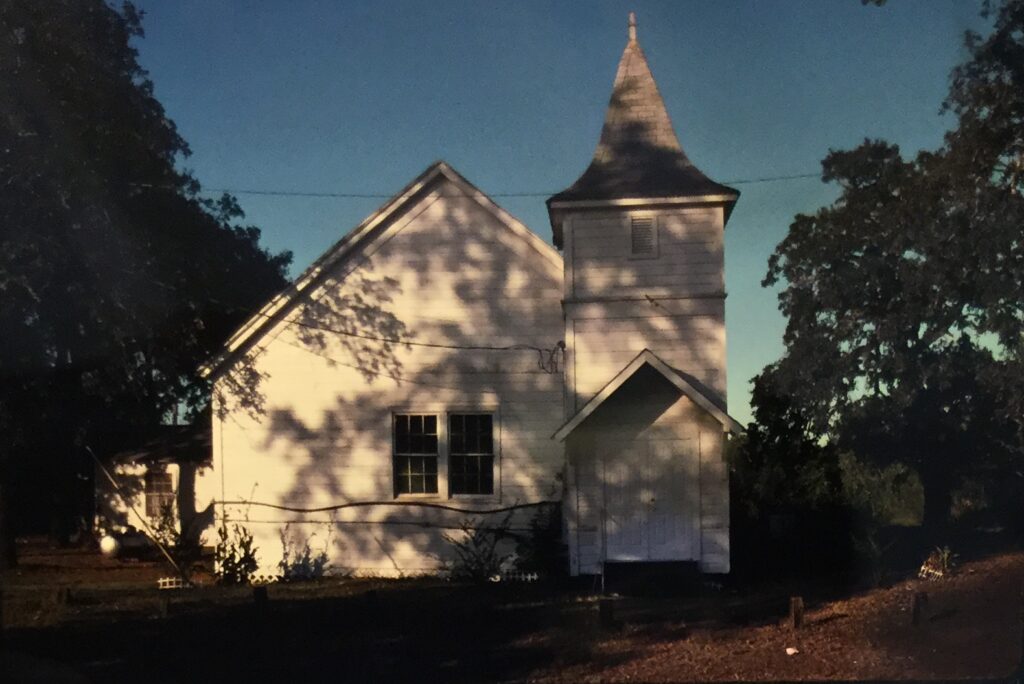
Although Dabney’s death in 1889 which occurred more than a decade before the historic Dabney Hill Missionary Baptist Church was built in 1905, his foresight to make provisions in 1882 for a place of worship while still alive was a harbinger for sustainability. He bought about 74 acres of land once owned by J. Hudson that was a part of James Hollingsworth survey. In a move to build generational wealth, Dabney conveyed twelve of those acres on the east corner of Hollingsworth and north corner of A. Colvin survey to his son Daniel Dabney Jr. in 1882, and the land became the cornerstone upon which the community built the historic church as well as the Ethiopian Star Lodge #308, an affiliated fraternal lodge of the The Most Worshipful Prince Hall Grand Lodge of Texas in Fort Worth. By the time the church was constructed, Dabney, Jr. conveyed his ownership of this portion of the Dabney, Sr. tract to fellow freedmen Washington Hoskins in 1894, and plans proceeded to build a church.
Freedmen welcomed the influx of foreign immigrants who trickled into the area to create settlements of their own nearby. Among them were the Czechs who established a colony called Sebesta that settled near Dabney Hill in the 1880s. The communities lived cooperatively. At the time, a post office had already been in operation in Dabney Hill. As commercial interests expanded, the Czechs requested a post office of thier own to enhance communication. Rather than have two separate post offices, John S. Snook, the postmaster in Caldwell, executed a compromise that arranged for the Dabney Hill post office to be relocated halfway between Dabney Hill and Sebesta. He commissioned the new post office that was named “Snook” in his honor, and the communities coalesced into the town of Snook that also preserved his name. In what was considered rare for African Americans in that day, Dabney Hill natives Robert E. Hoskins (b. 1859) and John A. Dabney (b. 1873) were appointed postmasters to oversee operations of the merged post office. Hoskins, son of pioneer Washington Hoskins and original lodge member, was appointed U.S. postmaster in Snook on February 20, 1895. Dabney, grandson of founder Dabney Sr. and original lodge member, was appointed postmaster in Snook on May 24, 1905. Both were active members in the Ethiopian Star Lodge.
Deprived of literacy during slavery, freedmen clamored for learning opportunities after Emancipation. They fostered education as the key to empowerment and uplift. The first Dabney Hill Colored School was organized in 1874 with founder Dabney Sr., David Napper, Sr., and John Munson, Sr. as trustees, although classes were not held in an actual building until the 1887. As segregation persisted, the Jones High School opened in 1950 in Dabney Hill as a county school. It was initially the Snook Colored High School. The school was named after T.W. Jones, a graduate of Prairie View A&M University, who served as its inaugural principal. The school officially closed in 1968 and merged with Snook ISD as a result of the landmark Brown v. Board of Education decision which ended segregated education.
Dabney Hill was approved by Texas Historical Commission in 2020 to receive a subject historical marker.
Church: Dabney Hill Baptist Church/ Dabney Hill Missionary Baptist Church
School: Jones High School/ Jones School Building/ Snook Colored High School