
St. John Colony (St. John’s/Wynn’s Colony)
Caldwell County, TX
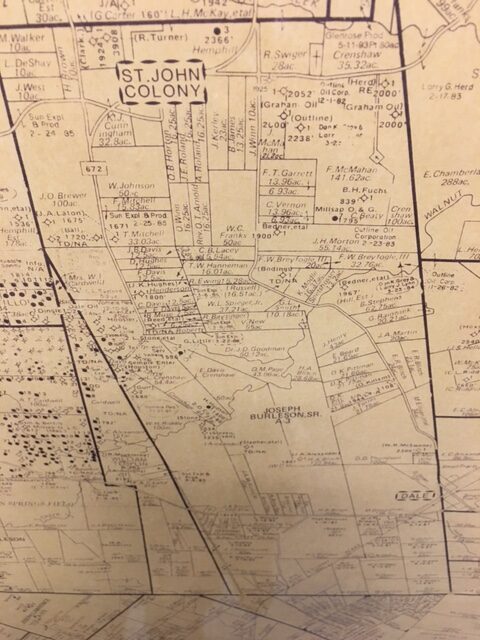
Status: Located
Year Established: 1872
Council of Governments: CAPCOG
Public History: https://tshaonline.org/handbook/online/articles/hrslq:
“St. John Colony is on Farm Road 672 ten miles northeast of Lockhart in northeastern Caldwell County. It was begun in the early 1870s by a group of black families who came from Webberville with the Rev. John Henry Winn to purchase land. The community was first called Winn’s Colony, but after the establishment of St. John Missionary Baptist Church in 1873, its name was changed to St. John Colony. The boundaries of the colony were somewhat nebulous, but it included an area of roughly 2,200 acres. St. John was the name given to the local school district in the 1870s, and it continued to be the focus of a common district until it was consolidated with Lockhart schools in the early 1960s. Residents maintained a school at the community until area public schools were integrated in 1966. The community had three churches in the 1980s, when about forty families lived in the area. In 2000 the population was 150.”
Community History: Between the years 1872 and 1879 there was a faithful Missionary Baptist Preacher, by the name of John Henry Winn, Senior, who lived in “Hogeye”, better known as, Webberville, Texas, situated near the Colorado River in Bastrop County. Perryville was nicknamed “Hogeye”. This town was located 2 ½ miles south of Elgin, Texas. Hogeye was given to the stage stop “The Litton House” because it was there that a community dance was held, the fiddler knew only one song, “Hogeye”. Reverend John Henry Winn, Sr., left Webberville, Texas on horseback looking for property which he and fourteen other families could purchase for their homes. He rode nearly 60 miles over hills, valleys, woods and creeks until he reached a place of 2,000 acres of forestland.
Living near this acreage, around Lytton Creek, were two families, the Bob Hayes’ and the Square Harrisons’. Rev. Winn talked with these two men and asked if the surrounding property was for sale. They gladly replied that it was. Because of the distance the preacher had traveled, Bob Hayes asked him to stay the night with him and his family. Early the next morning, Rev. Winn journeyed back to Webberville, Texas to tell his people that he had found the land for them; they rejoiced! Shortly thereafter, Rev. Winn and the heads of the fourteen families journeyed to the new land he had found.
They worked hard cutting down trees and cleaning the land so they could build their homes. Each family bought anywhere from 25 acres to 100 acres until the 2,000 acres was bought. After the first years the colony began to grow spiritually and economically. It was named “Winn’s Colony” after the Rev. John Henry Winn, Sr. A church was established in 1873 by the Rev. Winn, and named, “Saint John Missionary Baptist Church”. Winn’s Colony took the same name and today is known as Saint John Colony. Some of the industries developed in the Colony were:
Post Office Grocery Store Grist Mill
Cotton Gin Sorghum Mill Lodge Hall
Cotton Buying
Education was also a concern in the Colony. A school was built. It was controlled by its own Board of Trustees, who were elected from citizens within the community. They elected the administrative personnel, who were their teachers and principals. The school remained within the community until the early part of the 1960’s, and then it consolidated with the Lockhart Public Schools.
The first pioneers of the Colony were:
Rev. Calvin Allen Andrew J. Davis
Mose Hill Sister Jane Roland
Josiah Hill Lee Winn, Sr.
Berry O. Davis Joe Hill
Rev. John H. Winn, Sr. George Arnold
Cary Hill Lamar Hill
Billy Carter George Mackey
Cemetery: St. John Cemetery, Zion Cemetery
Church: St. John Missionary Baptist, (est. 1873), Zion Union Missionary Baptist, Landmark Baptist
School: Lytton Springs, St. John, St. Lytton