Cuney (Andy)
Cherokee County, TX
Status: Located
Year Established: 1870
Council of Governments: ETCOG
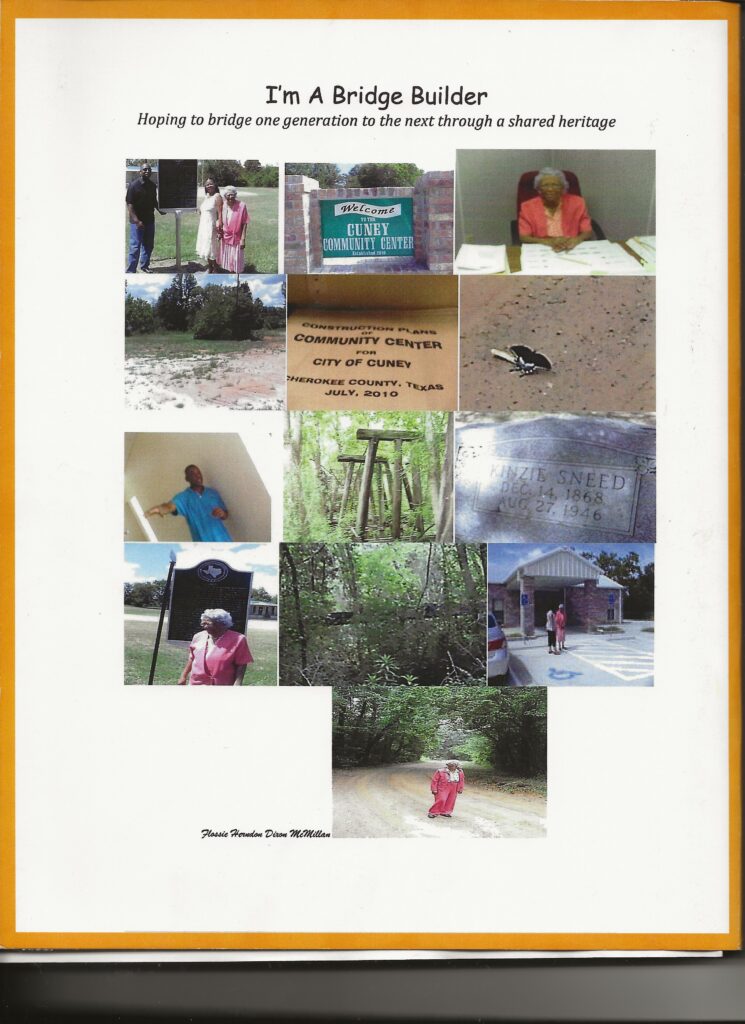
Public History: Ancestors of founder, Flossie Dixon McMillan, born 1919 and family book.
https://www.tshaonline.org/handbook/entries/cuney-tx:
Cuney is at the junction of U.S. Highway 175 and Farm Road 855, twenty-two miles northwest of Rusk in northwestern Cherokee County. The site was first settled by freed slaves just after the Civil War and was known for a time as Andy, after Andrew Bragg, a former slave and the first Black landowner in the area. A community, however, did not grow up until around 1902, when the settlement became a flag stop on the newly built Texas and New Orleans Railroad. Around 1914 H. L. Price, the cashier at the Farmers and Citizens Savings Bank in Palestine, and several other local investors formed a development company and platted a townsite. They named the town Cuney in honor of Price’s son, Cuney Price, who in turn had been named for Norris Wright Cuney, a prominent Black politician and head of the Republican party in Texas. A Cuney post office was authorized in 1917, and by the early 1920s the town had two general stores, a blacksmith shop, several cotton gins, an eleven-grade school, a drugstore, and a hotel. In 1929, when U.S. Highway 175 was paved, most of the town’s businesses moved to the highway, a mile north of the railroad. The town’s population reached 100 in 1929 but declined during the early 1930s; in 1936 only twenty-five residents and six businesses were reported. Afterward the population grew steadily, from seventy-five in 1952 to 170 in 1990 to 145 in 2000. When Cuney was incorporated in November 1983 it became the first incorporated Black community in Cherokee County. A number of businesses closed after World War II, but in the late 1980s the town still sustained a post office, two grocery stores, an arts and crafts shop, a beauty shop, a garage, and a sawmill.
https://en.wikipedia.org/wiki/Cuney,_Texas (too long)
Community History: Cuney: Told by Aunt Flossie
Cuney Yesterday and Today
Around the late 20’s, early 30’s, when Highway 175 was built, it bypassed the small thriving town of Cuney, Texas. Since then, there have been many changes. All of the businesses are gone. The Masonic Hall is also gone. The post office moved to Highway 175. The cotton gin was moved to the new Highway also. Cuney as I knew it is no more.
The Braggs, Sneeds, Kissentaners, Burrells, Pierces, Prices, Battles, Blantons, Nelsons, and many others are all gone and the places where they lived are no longer there.
It is my intention, in writing the history of Cuney and telling my story, for the generations coming along to know about their history. That it was once a thriving town for Blacks.
I grew up with Cuney. So much of the history of Cuney I knew and remember from my childhood. My story is dedicated to the pioneers of Cuney. They won’t know anything about it, but their children will.
Cuney was built at end of the Civil War when slaves were free. There was nothing less than happiness and joy and all jubilation at the end of Civil War. Oh, the dancing in the cotton fields, and singing at night, praising God “We are free!”
After a few weeks of celebration he slaves look at each other and started thinking, “Yes, we are free; but what now? We have no place to go. What will we do? How will we live?” Reality set in. Three men, Nelson Sneed, March Kissentaner, and Andy Bragg pooled their resources and bought 800 acres of land and sold it.
Cuney, Texas, first known as Andy the only town in the state known to have been founded by black slaves for black slaves who had nowhere to go. The name Andy came from Andrew “Andy” Bragg, a former slave who became the owner and operator of extensive farmland in the area.
Andy Bragg is credited with being the first settler. He bought a farm there in 1870, which gave the community its first name. Other blacks bought land in the same area in the Post-Civil War period. Nelson Sneed and March Kissentaner bought a farm together in 1871. Kissentaner bought another 320 acres of land in 1872. Sneed bought another 257 acres of land in 1873. Kissentaner increased his holdings by purchasing 157 more acres in 1893.
Sneed was a fortunate black, Bishop Sneed, his grandson, said years later in recounting the community’s history. A Dr. Dodson, who owned Sneed, paid him wages and let him work his way to freedom from slavery in that way, much as was the custom of an indentured person. By 1858, Sneed was a free man and owned 800 or more acres of land in the Cuney area. He was one of the founders of the community, and some of his descendants still reside there and are active in town. Bishop Sneed was postmaster at Cuney many years; was an oil and gas land lease operator in East Texas, even drilled for oil in Tennessee, without finding production.
All of the first settlers were former slaves freed from the Pre-Civil War farms and plantations in that area.
From 1893 – 1917, news spread like wildfire that there was a town established by freed slaves for freed slaves. These three men, Nelson Sneed, March Kissentaner, and Andy Bragg went through the county selling the land for 50 cents an acre to newly freed slaves. Their slogan, “Come! Come! Come to Cuney! Help us build a town where you can have your own churches; where your children can have their own schools!” In Grandpa’s words, “Be somebody!” And they came in droves. They came walking with their meager belongings on their backs. They came walking laden with hoe on their shoulders. They came in buggies. They came with trunks on back of wagons. They came with just the clothes on their backs. “Come! Come! Come to Cuney!” And they came in droves.
Author: Flossie Herndon Dixon McMillan
Submitted by: Nedra D. Sneed Ballard