Robinsonville
McLennan County, TX
Status: Located
Year Established: 1852
Council of Governments: HOTCOG
Public History: Robinson, on State Highway 77 six miles south of Waco in central McLennan County, came into existence after brothers John and Levi Robinson established homesteads in the area in the early 1850s. The original Robinson home was built on land that later became the J. W. Mann farm. To encourage the growth of the village in 1856, the brothers surveyed 171 acres of land and marked off forty-two four-acre lots for other homesteaders. The Robinsons sponsored the settlement’s first school in 1860, when they hired a private tutor for their children. The teacher, Mr. Moore, lived with the Robinson families. From 1879 to 1906, Robinson had its own post office. Postmasters included J. R. Robinson and L. B. Foster, both of whom also operated general stores. In 1885 Robinson had a population of 600 that supported three cotton gins, two churches, three general stores, and a school. J. W. McKee and Sons, a broom factory, was also in operation. In 1888 Rev. John Strauss founded the Robinson Academy. The weekly newspaper was the Robinson Bulletin. By the late 1890s, the population had dropped to 300 despite the continued operation of the broom factory. Three churches were built during the latter years of the nineteenth century-the Baptist church in 1866, the Presbyterian church in 1874, and the German Evangelical Lutheran church in 1884. Social clubs founded in the early twentieth century and still functioning as late as the 1950s included the Merry Robins and the Chatter Club. Robinson was incorporated in 1955. In 1958 its site comprised twelve square miles adjacent to Waco. Business owners organized the chamber of commerce in 1957. By 1960 the population had grown to 2,110. Residents numbered close to 7,000 in 1980. In 1982 the town had its own water system fed by seven artesian wells, as well as its own sewer system. The same year, Robinson had a volunteer fire department, a police department, and a unit of the Texas Department of Public Safety. In 1990 the town was primarily residential. It had a population of 7,111 and numerous small businesses. Although it had a contract post office, residents were served by the Waco postal service. The Robinson Independent School District consisted of a high school, a junior high, and three elementaries. In 2000 the population reached 7,845.
Community History: “In 1852, John Robinson arrived in Central Texas, from Demopolis, Alabama, with his family and six slaves, founding what would soon become known as Robinsonville. Two years later, his brother Levi joined him, bringing his own family and an additional four slaves. Among Levi’s slaves was a man named (Jim) Orand Bonner. According to family lore, Levi sent Orand and several other men to a Mill in Jefferson County to pick up lumber. While at the Mill, Orand met a slave woman named Millie Stewart. The two married and Millie became the nanny for the Robinson family. Millie had three children from a previous marriage, and would have several more children with Orand. In 1860, the Robinsons hired a tutor for their children. Since Millie was their nanny, her children were allowed to learn some limited lessons from the tutor as well.
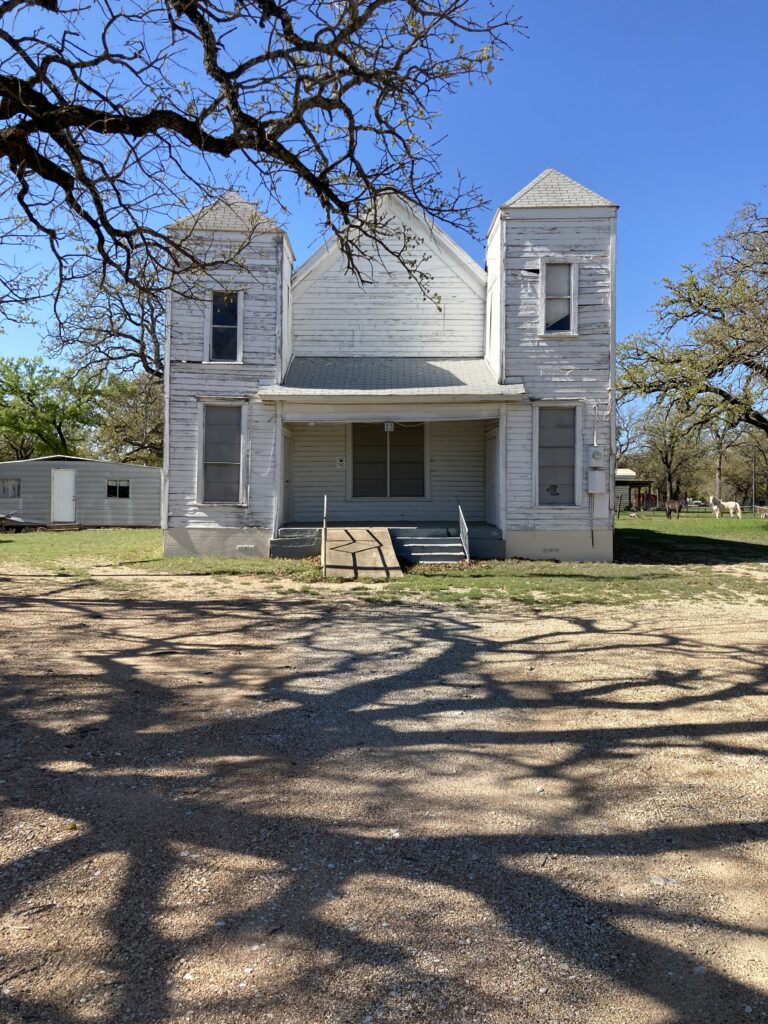
After emancipation, the black community in Robinsonville grew quickly. Millie remained close with the Robinson family and with the children whom she had nursed and helped raise. In 1881, John Robinson’s son, Edward L. Robinson, gave just under 5 acres of land to Millie, with the stipulation that the land be used for educational purposes. Millie’s husband and two other men signed for the property. The community decided not only to build a school, but also a church on the plot of land. In 1882 members of the community completed St. Paul Missionary Baptist Church and the Post Oak Academy. In April of that year St. Paul held its first services under the leadership of E. H. Harris, the first pastor of the church, and an original trustee of the school.
The school and the church were closely connected. Most of the families of the area attended the church and sent their children to the school. C.H. Dorsey was one of the early headmasters of the Post Oak Academy. Dorsey also organized the church choir and served as a Church Trustee and Sunday School Superintendent. Children could stay after school on Friday afternoons for choir practice in order to perform on Sunday mornings. The school had two rooms, two teachers, and taught up to a seventh grade level. Some children continued their education at A.J. Moore High School in Waco.
A block over from the church, a cemetery provided a final resting place for the community. People buried there include men and women born in slavery, as well as veterans of World War I and II and several other wars. There is a mix of beautifully crafted headstones, hand carved memorials, and various other markers. Today, descendants of the black community continue to bury loved ones in this local cemetery.
Over time, the demographic of the area changed, as many Americans gradually moved out of the area. The school was destroyed by fire in the 1920s when it was struck by lightning, and was never rebuilt. Even the town itself changed, from Robinsonville to Robinson in 1955. However, St. Paul Missionary Baptist Church is still in existence today and descendants of Millie Bonner and other original families continue to attend. The congregation gathers each Sunday to worship and serve the community, just as the church was commissioned to do over 130 years ago.”
Church: St. Paul Missionary Baptist Church (est.1881, remodeled 1923)
School: Post Oak Academy